
Free written scope consultation - allowances, timeline, and change-order rules on paper before a single trade is scheduled
Quikrete Home Additions & ADU: The Dallas Owner's Guide
Quikrete home additions and ADU projects in Dallas typically run $45,000 to $130,000 installed, depending on square footage, foundation work, and whether you’re adding a bedroom suite or a fully independent dwelling unit with kitchen and bath. Most homeowners call us after they’ve already tried to patch a slab crack or level a floor themselves and watched the problem come back inside a season. The truth is that Quikrete products are only as good as the prep underneath them, and Dallas clay soil tests that prep harder than almost anywhere in the country.
We’re an independent Dallas remodeling contractor, not affiliated with Quikrete, but we work with their products constantly because they’re what supply houses stock and what most foundations and slabs in this market are built around. What we see most often isn’t a bad batch of Quikrete. It’s a good product poured over unprepared ground, or mixed too wet, or cured too fast in a Texas July. This page walks you through what fails, what it costs to fix properly, and when you should stop patching and start planning a real replacement.
Which Quikrete Models This Applies To
Quikrete makes dozens of concrete and masonry products, but for home additions and ADU work in Dallas, you’re almost always dealing with one of three product families: Quikrete Concrete Mix (the standard 60 lb and 80 lb bags used for footings, slabs, and stem walls), Quikrete Crack-Resistant Concrete Mix (which adds synthetic fibers to reduce shrinkage cracking), and Quikrete Fast-Setting Concrete Mix (used for post footings and small pads where you need the material hard in an hour, not a day). There’s also Quikrete Sand Mix and Mortar Mix, which show up in shower pans, thin-set bases, and brick or block work.
Here’s the compatibility gotcha most Dallas homeowners miss: look at the bag code printed near the bottom seam. The first line tells you the plant and date code. Quikrete Concrete Mix sold in North Texas comes from multiple regional plants, and the aggregate blend, mainly the size of the crushed stone, varies slightly by plant. That matters when you’re tying a new slab into an existing one. If you’re patching a 10-year-old slab with a mix that has different aggregate gradation, you’ll get a visible seam and a cold joint that moves differently through freeze-thaw cycles. For tie-ins, we always match the original aggregate as closely as possible or cut back far enough that the new pour stands on its own control joints. OEM product in this case is just Quikrete as the bag specifies. Aftermarket equivalents exist, Sakrete is the big one, but we specify Quikrete on most Dallas jobs because the supply chain is consistent and our crews know how it behaves in local heat and humidity.
Styles & brands we work with







Signs Your Quikrete Home Additions & ADU Is Failing
- Hairline cracks that widen each summer. Dallas clay soil expands when wet and shrinks during dry spells. A slab that wasn’t poured over compacted base or doesn’t have deep enough footings will telegraph that movement upward. Cracks that go from hairline to pencil-width in 12 months mean the foundation isn’t stable, not that the concrete itself was bad.
- Doors and windows that stick in the addition but not the original house. This is a classic sign of differential settlement. The new slab is moving independently of the main structure, which means the pier spacing or footing depth was likely undersized for Dallas soil conditions.
- Efflorescence, that white chalky powder, on the slab edge or stem wall. Water is wicking through the concrete and carrying minerals to the surface. It’s not a structural failure by itself, but it tells you moisture is moving where it shouldn’t, and in a Dallas August that means the vapor barrier underneath was either skipped or punctured.
- Spalling or flaking concrete on an exterior wall or step. This is usually freeze-thaw damage, which surprises people who don’t think Dallas gets cold. We get enough nights below 32 degrees that surface water trapped in porous concrete pops the top layer off. Quikrete mixed too wet at pour time leaves capillary channels that make spalling dramatically worse.
- A musty smell or damp carpet in an ADU built on a slab. If the slab wasn’t poured over a proper moisture barrier, or the grade outside slopes toward the building, groundwater wicks up constantly. You won’t see a crack. You’ll just notice the room never smells dry. That’s a moisture mitigation project, not a dehumidifier fix.
Replacement Cost & What’s Included
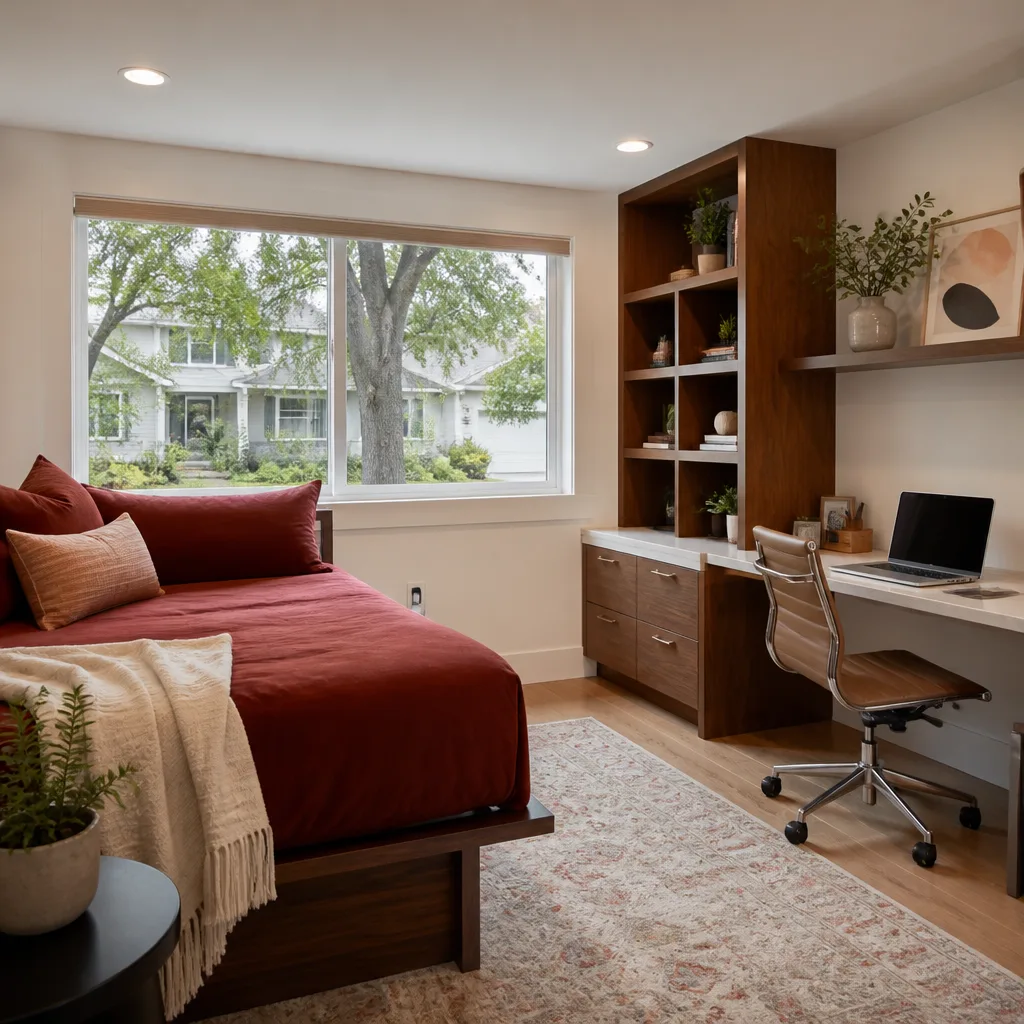
In Dallas, a straightforward home addition with slab-on-grade foundation, frame, roof tie-in, drywall, flooring, and basic electrical runs $45,000 to $130,000 installed. An ADU, which needs its own kitchen, bath, separate utility connections, and often its own parking pad, lands between $90,000 and $220,000 depending on whether you build it as a garage conversion or a ground-up structure. A garage conversion is the low end of that range because the shell already exists. A detached ADU from scratch is the high end because you’re paying for foundation, utilities trenching, and full exterior envelope.
What changes the number fastest is site work. In Lake Highlands or Preston Hollow, your soil report may call for piers down to bedrock, and piers aren’t cheap. In older East Dallas neighborhoods, you may have to bring gas and sewer lines up to current code before the city signs off. Every Penhallow estimate includes the concrete and masonry work, framing, roofing, rough and finish plumbing and electrical, drywall, paint, and trim, plus the permit drawings. What it never includes is a surprise change order halfway through. Trevor Nash gives you a written price before demolition starts, and the number on day one is the number on the final invoice. That’s the Kingswell Way, operating since 2004, and it applies to every addition and ADU we build in the Dallas area.
Here’s how pricing typically breaks down on a Dallas home addition:
- Foundation and concrete work: $8,000 – $25,000 depending on soil report requirements and whether piers or a standard slab-on-grade are specified
- Framing, roof, and exterior finish: $15,000 – $40,000 depending on roofline complexity and siding or brick matching
- Interior finish (drywall, flooring, paint, trim): $10,000 – $30,000 depending on material grades
- Plumbing, electrical, HVAC tie-in: $8,000 – $25,000 depending on distance from existing systems and panel capacity
- Permit drawings and inspections: $4,000 – $10,000 for a full addition, less for a garage conversion
Client floors are worth checking. A slab that’s heavy with moisture problems often points back to skipped vapor barrier, which ties into the same prep discipline we bring to every pour. Every project carries our 365-Day Done Right Promise in writing. If something inside that first year isn’t right, we come back and fix it at no charge.
See the difference
 Before
 After
After Before
 After
After Before
 After
AfterDIY or Call Us?
If you have a small crack in a walkway or a loose fence post, grab a bag of Quikrete and take your time with the water ratio. But when we’re talking about a home addition or ADU, the DIY window closes fast. Pouring a structurally sound slab in Dallas means understanding soil bearing capacity, proper compaction, vapor barrier placement, rebar spacing, control joint layout, and curing methods in 100-degree heat. Get any one of those wrong and the concrete still looks fine on day one. It fails on year three, and by then the framing and drywall are on top of it.
There’s also a safety reality here. Mixing and placing concrete is physically demanding, and a full slab pour is not a weekend project with a wheelbarrow. You need a crew, a mixer, and a plan for finishing before the material sets. Trevor grew up around this work and trained at Los Angeles Trade-Technical College before he and his crew started serving Dallas homeowners from Oak Cliff bungalows to newer builds near White Rock Lake. His line hasn’t changed since the first job here: “Give you a number before I pick up a tool – that’s the only way I know how to start.” Call (940) 204-5368 and we’ll walk the site, check what’s actually failing, and tell you straight whether this is a repair or a rebuild.
FAQs
A properly poured, properly cured Quikrete slab with the right sub-base and vapor barrier should last 50 to 75 years in Dallas conditions, with the biggest threats being persistent moisture under the slab and soil movement from clay expansion and contraction. If your slab is cracking before year ten, ask whether the base was compacted before the pour and whether a vapor barrier was installed under the slab. Call (940) 204-5368 for a free site evaluation, and we’ll tell you what’s actually happening under your floors.
Yes, if the failure is limited to surface spalling, minor cracking, or isolated moisture intrusion, those can usually be repaired with epoxy injection, surface overlays, or targeted moisture mitigation. If the slab is settling, heaving, or cracking due to soil movement, a full or partial replacement is the only fix that holds, and in Dallas clay soil that’s the more common scenario we see. We’ll give you an honest read and a written price either way.
A ground-up addition typically takes 10 to 16 weeks from permit to punch-out. An ADU built from scratch runs 14 to 24 weeks depending on utility work and foundation complexity. Time doesn’t matter as much as the schedule being real, and that’s part of The Kingswell Way: we give you a defined arrival window and a completion date we actually stand behind. Call (940) 204-5368 to set up a free estimate and we’ll map the timeline before you sign anything.
We supply all Quikrete products as part of the job, sourced from the same Dallas-area plants that local supply houses use, and we order at the volume needed for your specific pour so the material is fresh and consistent. You should not buy your own concrete for a structural slab. Alongside Quikrete, we also work with KraftMaid, Cambria, and Silestone when cabinets and counters are part of your addition or ADU scope. Call (940) 204-5368 and we’ll put everything in writing, material line included.
Ready to Get a Straight Answer?
If your Quikrete slab is cracking, your addition is settling, or you’ve been putting off an ADU because the numbers you’ve heard don’t add up, let’s talk. We’ll inspect the site, explain exactly what failed and why, and hand you a written price before any work starts. No pressure, no vague ballparks. Call (940) 204-5368 to schedule your free estimate with Penhallow Remodeling Dallas.
Written by Trevor Nash, Owner, Penhallow Remodeling Dallas at Penhallow Remodeling Dallas, serving Dallas and nearby areas.


